
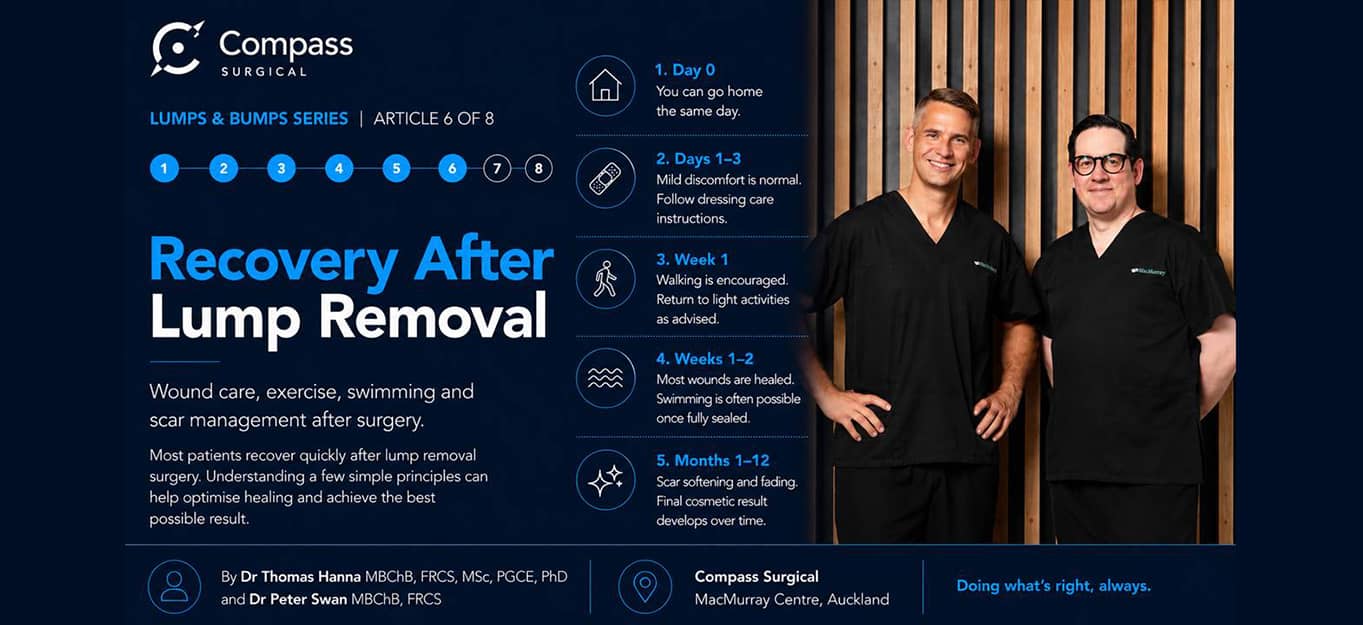
By Dr Thomas Hanna MBChB, FRCS, MSc, PGCE, PhD and Dr Peter Swan MBChB, FRACS
Compass Surgical | MacMurray Centre, Auckland
This is Article 6 of 8 in our guide to skin lumps, bumps and minor surgical procedures.
In our previous article, What Are the Risks of Lump Removal?, we discussed the potential complications of surgery and how those risks are minimised.
Fortunately, most patients recover quickly and uneventfully after lump and bump removal.
One of the most common questions we hear is:
“What should I do after the procedure?”
Closely followed by:
“When can I shower?”
“When can I swim?”
“How do I get the best possible scar?”
Understanding a few simple principles can help make recovery smoother and optimise healing.
Most patients experience:
These symptoms are a normal part of healing and generally improve steadily over the first few days.
Many patients require only simple pain relief.
At the end of the procedure, a dressing will usually be applied to protect the wound.
The type of dressing depends on the location of the wound and the procedure performed.
You will be given specific instructions regarding:
Following these instructions carefully is one of the simplest ways to support uncomplicated healing. Patients seeking additional information about wound care and preventing wound infections may find the Healthify NZ wound care resources helpful.
In most cases, yes.
Many modern dressings are designed to tolerate showering.
As a general guide:
If you are unsure, it is always best to check with your surgeon or practice nurse.
Swimming is one of the most common questions after surgery.
Pools, spas, lakes and the ocean all contain bacteria that may increase the risk of infection if a wound has not fully healed.
For most patients, we recommend waiting until:
For many patients, this means waiting around one to two weeks, although larger wounds may require longer.
Gentle activity is encouraged from the day of surgery.
Walking promotes circulation and supports recovery.
More strenuous activity depends on:
As a general guide:
The key principle is gradual progression.
If an activity causes significant discomfort, it is usually sensible to allow a little more healing time.
Many patients are understandably interested in achieving the best possible cosmetic result.
It is important to remember that every surgical incision leaves a scar.
Initially, scars often appear:
This is completely normal.
Most scars gradually soften and fade over several months.
Simple measures that may help optimise scar appearance include:
Patience is important. Scar maturation continues long after the skin has healed.
This depends on the type of stitches used.
Some sutures dissolve naturally and do not require removal.
Others are removed by your surgeon, practice nurse or GP.
The timing varies depending on the location of the wound and the procedure performed.
Your postoperative instructions will explain what is required in your particular case.
Most wounds heal without difficulty.
However, you should seek medical advice if you notice:
Early assessment often prevents minor issues from becoming more significant problems.
One of the most important things patients can understand is that healing continues long after the skin appears normal.
The surface of the wound may heal within days or weeks, but the deeper tissues continue to remodel and strengthen for many months.
This is entirely normal and explains why scars continue to change long after surgery.
At Compass Surgical, we believe successful outcomes depend not only on the procedure itself but also on good postoperative care.
Our approach is built around:
We provide detailed recovery instructions, review pathology results and remain available to answer questions during the healing process.
If you would like advice regarding a cyst, lipoma, skin lesion or soft tissue lump, you can book an appointment with one of our surgeons at the Compass Surgical Contact page.
Once the wound has healed, most patients are keen to know what was actually removed and what the pathology results mean.
In the next article, “What Happens to My Lump After It Is Removed?”, we’ll explain how tissue is analysed, how pathology reports are interpreted and what happens if something unexpected is found.
_________________________________________________________________________________________________
Can I shower after lump removal?
Usually yes. Most modern dressings allow showering, although you should follow the specific advice provided after your procedure.
When can I swim?
Most patients should wait until the wound has fully healed and any stitches have been removed.
Is bruising normal?
Yes. Mild bruising and swelling are common parts of the healing process.
How long will the scar remain visible?
Scars continue to mature and fade for many months after surgery.
When should I seek medical advice?
If you develop increasing pain, redness, discharge, fever or wound separation, you should seek review.
You may also find these articles helpful:
• What Are the Risks of Lump Removal? (Article 5)
• Looking After Your Wound After Lump Removal (Article 7)
• What Happens During Lump and Bump Removal? (Article 4)
_________________________________________________________________________________________________
Dr Thomas Hanna MBChB, FRCS, MSc, PGCE, PhD
Dr Thomas Hanna is a general and transplant surgeon practising in Auckland. He trained in the United Kingdom before moving to New Zealand in 2019. He has specialist interests in hernia repair, gallbladder surgery, minimally invasive surgery and the management of skin lesions and soft tissue lumps. Tom is a founding partner of Compass Surgical and is committed to patient-centred surgical care, clear communication and surgery performed with integrity.
Dr Peter Swan MBChB, FRACS
Dr Peter Swan is a general surgeon practising in Auckland with expertise in skin lesions, soft tissue lumps, hernia repair and gallbladder surgery. He is a founding partner of Compass Surgical. Peter’s practice focuses on practical, evidence-based advice, careful patient selection and personalised treatment.
_________________________________________________________________________________________________
Compass Surgical
Doing what’s right, always.


© 2026 Compass Surgical All Rights Reserved | Privacy Policy | Terms & Conditions | Web Design by Virtual Innovation