
By Dr Thomas Hanna MBChB, FRCS, MSc, PGCE, PhD and Dr Peter Swan MBChB, FRACS
Compass Surgical | MacMurray Centre, Auckland
This is Article 5 of 8 in our guide to skin lumps, bumps and minor surgical procedures.
In our previous article, What Happens During Lump and Bump Removal?, we discussed what patients can expect on the day of their procedure.
The next question is often:
“What could go wrong?”
It is an important question.
At Compass Surgical, we believe patients should understand both the benefits and the potential risks of any procedure before making a decision. Patients who would like additional information about surgical risks and informed consent may also find the Royal Australasian College of Surgeons (RACS) patient information resources helpful.
The good news is that most lump and bump procedures are straightforward, performed under local anaesthetic, and associated with a very low risk of serious complications.
However, no surgical procedure is entirely risk-free.
Understanding those risks helps patients make informed decisions and approach treatment with realistic expectations.
For most patients, yes.
Minor surgical procedures such as the removal of cysts, lipomas, skin lesions and other soft tissue lumps are performed safely every day.
Most patients experience uncomplicated healing and return quickly to normal activities.
The risks are generally small, particularly when the lump is benign, well-defined and located in an area that is straightforward to treat.
This is often the most important question for patients.
The simple answer is yes.
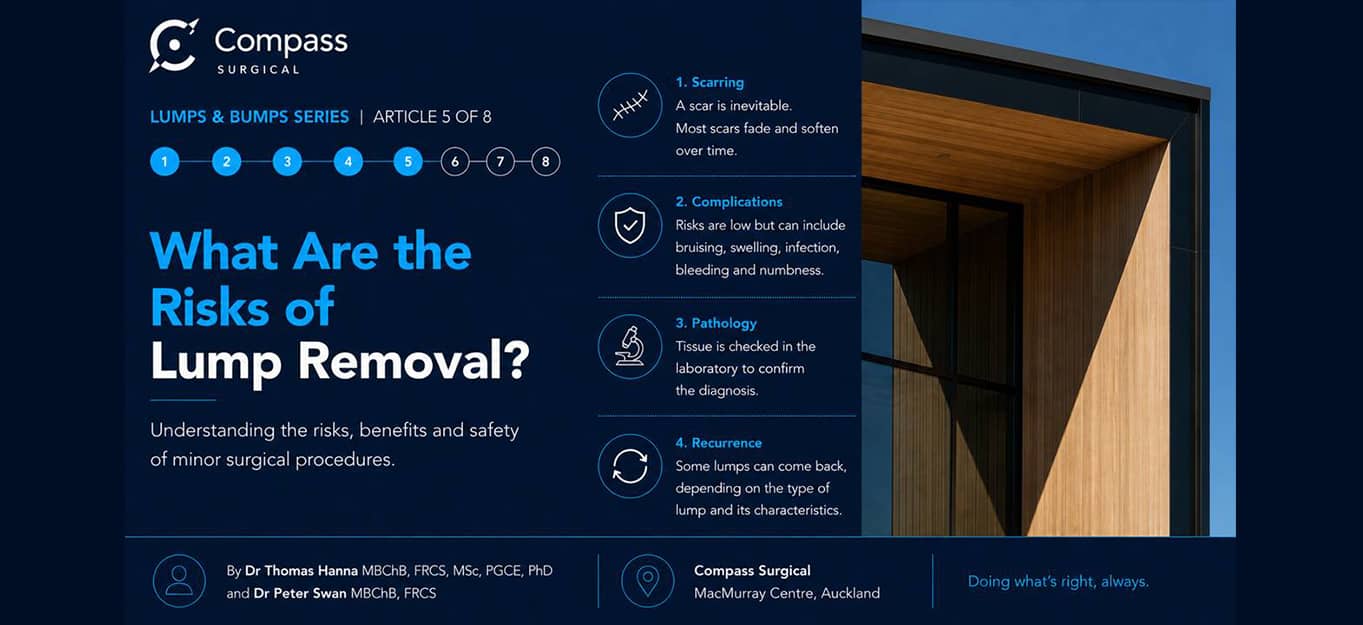
Any procedure that involves cutting the skin will leave a scar.
Our goal is always to place incisions carefully and achieve the best possible cosmetic result, but no surgeon can remove a lump without leaving some degree of scarring.
Fortunately, most scars soften and fade significantly over time.
Factors that influence scar appearance include:
We’ll discuss scar care and wound management in more detail in the next article.
The most common complications are usually minor and temporary.
These include:
These symptoms are a normal part of healing and usually improve steadily over days or weeks.
Yes, although infection is uncommon.
Signs of infection may include:
Most infections respond well to simple treatment if identified early.
Patients are given instructions on what to look out for and how to seek advice if concerns arise.
Sometimes.
The risk depends on the type of lump being removed.
For example:
Where recurrence is a recognised possibility, this is discussed before surgery.
Small nerves run throughout the skin and underlying tissues.
Occasionally, removal of a lump can result in:
In most cases, these symptoms improve with time.
Permanent changes in sensation are uncommon but can occur, particularly when lumps are located close to important nerves.
Most pathology reports confirm the diagnosis that was suspected before surgery.
Occasionally, however, the laboratory identifies something unexpected.
This is one of the reasons most removed tissue is routinely sent for histological examination.
If further treatment or follow-up is required, your surgeon will discuss the results and the next steps with you.
This depends on the diagnosis.
Many benign lumps can safely be observed.
However, leaving a lump untreated may sometimes result in:
The decision to proceed with surgery should always balance the potential benefits against the risks of treatment.
Compass Surgical was founded on a simple principle:
Do the right operation, for the right patient, at the right time.
Our practice is built around:
We believe discussing risks openly is an essential part of good surgical care.
Our goal is not simply to remove a lump.
Our goal is to ensure patients understand the risks, benefits and alternatives so they can make informed decisions with confidence.
If you would like to learn more about treatment options for cysts, lipomas, skin lesions and soft tissue lumps, visit the Compass Surgical contact page to book a consultation with one of our surgeons.
Fortunately, most patients recover quickly after lump removal.
Understanding how to care for the wound, when to return to exercise and how to achieve the best possible scar can make recovery smoother and less stressful.
In the next article, “Recovery After Lump Removal”, we’ll discuss wound care, showering, swimming, exercise, scar management and what to expect during the healing process.
________________________________________
Is lump removal a safe procedure?
Yes. Most lump and bump procedures are straightforward and associated with a low risk of serious complications.
Will I have a scar?
Yes. Any procedure that cuts the skin will leave a scar, although most scars fade considerably with time.
Can a lump come back after removal?
Some types of lumps can recur, although many are removed permanently.
What is the most common complication?
Minor bruising, swelling and temporary discomfort are the most common issues after surgery.
Will the lump be tested?
In most cases, yes. Removed tissue is usually sent for pathological examination to confirm the diagnosis.
You may also find these articles helpful:
• What Happens During Lump and Bump Removal? (Article 4)
• Recovery After Lump Removal (Article 6)
• Do I Need Surgery for My Lump or Bump? (Article 3)
________________________________________
Dr Thomas Hanna MBChB, FRCS, MSc, PGCE, PhD
Dr Thomas Hanna is a general and transplant surgeon practising in Auckland. He trained in the United Kingdom before moving to New Zealand in 2019. He has specialist interests in hernia repair, gallbladder surgery, minimally invasive surgery and the management of skin lesions and soft tissue lumps. Tom is a founding partner of Compass Surgical and is committed to patient-centred surgical care, clear communication and surgery performed with integrity.
Dr Peter Swan MBChB, FRACS
Dr Peter Swan is a general surgeon practising in Auckland with expertise in skin lesions, soft tissue lumps, hernia repair and gallbladder surgery. He is a founding partner of Compass Surgical. Peter’s practice focuses on practical, evidence-based advice, careful patient selection and personalised treatment.
________________________________________
Compass Surgical
Doing what’s right, always.


© 2026 Compass Surgical All Rights Reserved | Privacy Policy | Terms & Conditions | Web Design by Virtual Innovation