
By Dr Thomas Hanna MBChB, FRCS, MSc, PGCE, PhD and Dr Peter Swan MBChB, FRACS
Compass Surgical | MacMurray Centre, Auckland
This is Article 7 of 8 in our guide to skin lumps, bumps and minor surgical procedures.
In our previous article, Recovery After Lump Removal, we discussed wound care, exercise, swimming, scar management and what to expect during the healing process.
Once the procedure is over, many patients have another important question:
“What happens to the lump now?”
Closely followed by:
“Will it be tested?”
and
“How will I get the results?”
These are important questions.
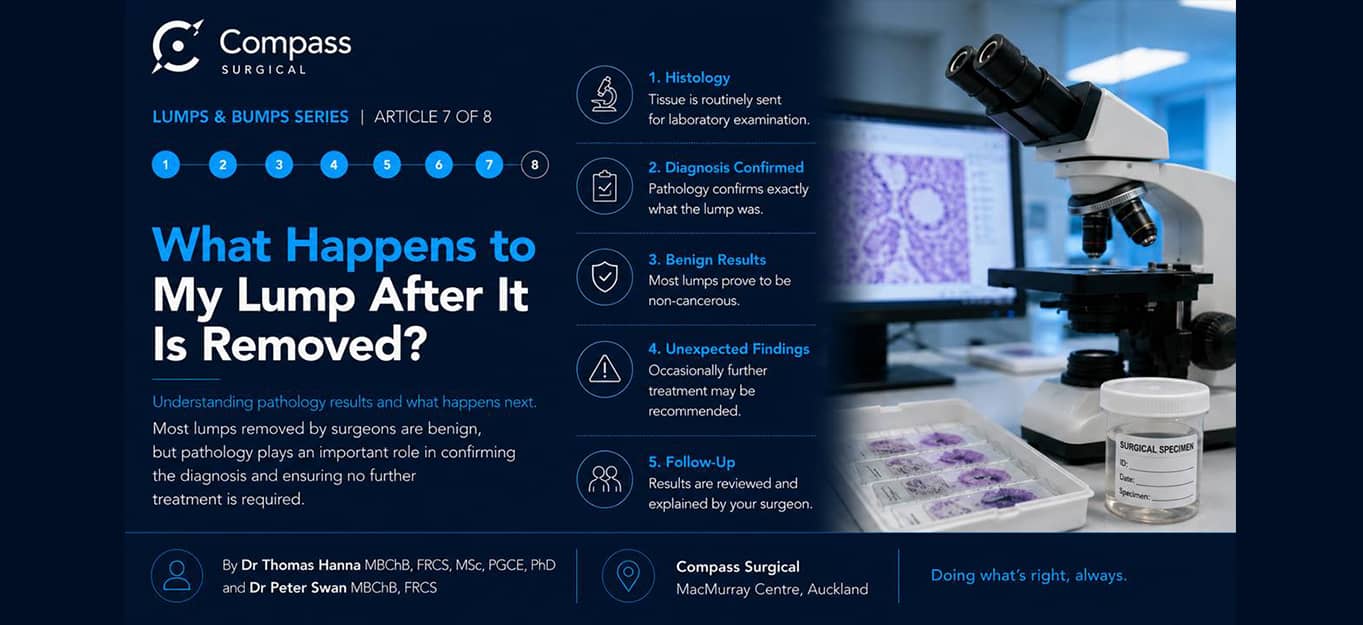
Although most lumps removed by surgeons are benign, pathology results play an important role in confirming the diagnosis and ensuring that no further treatment is required.
In most cases, yes.
Tissue removed during surgery is usually sent to a specialist pathology laboratory for examination.
This process is known as histology.
The purpose is to:
In many cases, the pathology result confirms exactly what was suspected before surgery.
A pathologist is a doctor who specialises in examining tissue under a microscope.
After your procedure, the specimen is carefully processed and analysed.
The pathologist prepares a report describing:
This report is then sent to your surgeon.
Patients interested in learning more about how pathology testing works can find additional information through the Royal College of Pathologists of Australasia (RCPA), which provides patient information explaining how tissue samples are analysed and reported.
The timing varies slightly depending on the type of specimen and the complexity of the analysis.
For most routine lumps and skin lesions, results are available within one to two weeks.
Occasionally, additional testing may be required, which can take longer.
If there are any unexpected findings, your surgeon will discuss them with you promptly.
The good news is that most pathology reports confirm a benign diagnosis.
Common findings include:
For many patients, the pathology report simply provides reassurance that no further treatment is needed.
Occasionally, pathology identifies something that was not obvious before surgery.
Examples may include:
While this can understandably cause anxiety, it is one of the reasons pathology is so valuable.
Identifying these conditions early often allows them to be treated effectively.
Most patients undergoing lump removal do not have cancer.
However, if a malignancy is identified, your surgeon will explain:
Depending on the situation, this may involve:
Importantly, early diagnosis often leads to excellent outcomes.
At Compass Surgical, pathology results form an important part of follow-up care.
Results may be discussed:
The exact process depends on the nature of the procedure and the result itself.
Our goal is to ensure patients understand the findings and have the opportunity to ask questions.
For many patients, pathology provides something just as valuable as treatment:
certainty.
Knowing exactly what has been removed allows patients to move forward with confidence.
It also helps guide any further care if required.
While most results are reassuring, pathology remains an important safeguard and a routine part of high-quality surgical practice.
At Compass Surgical, we believe every patient deserves clear communication and a complete understanding of their diagnosis.
Our approach is built around:
Removing a lump is only part of the process.
Understanding what it was and what it means is equally important.
If you have a skin lesion, cyst, lipoma or soft tissue lump that requires assessment, you can contact Compass Surgical to arrange a consultation.
Receiving a reassuring pathology result is often the final step in treatment.
However, many patients still have questions about long-term healing.
Will the scar continue to improve?
Could the lump come back?
Do I need ongoing follow-up?
Should I monitor the area in the future?
In the final article of this series, “Long-Term Results After Lump Removal”, we’ll discuss scar maturation, recurrence, long-term outcomes and what patients can expect in the months and years following treatment.
________________________________________
Will my lump be sent to a laboratory?
In most cases, yes. Removed tissue is usually examined by a pathologist to confirm the diagnosis.
How long do pathology results take?
Most results are available within one to two weeks, although some specimens require additional testing.
What is histology?
Histology is the microscopic examination of tissue by a specialist pathologist.
What happens if the result is unexpected?
Your surgeon will discuss the findings with you and explain whether any further treatment or follow-up is required.
Are most pathology results benign?
Yes. The vast majority of lumps and bumps removed by surgeons are non-cancerous.
You may also find these articles helpful:
• Recovery After Lump Removal (Article 6)
• Long-Term Results After Lump Removal (Article 8)
• Do I Need Surgery for My Lump or Bump? (Article 3)
• What Happens During Lump and Bump Removal? (Article 4)
________________________________________
Dr Thomas Hanna MBChB, FRCS, MSc, PGCE, PhD
Dr Thomas Hanna is a general and transplant surgeon practising in Auckland. He trained in the United Kingdom before moving to New Zealand in 2019. He has specialist interests in hernia repair, gallbladder surgery, minimally invasive surgery and the management of skin lesions and soft tissue lumps. Tom is a founding partner of Compass Surgical and is committed to patient-centred surgical care, clear communication and surgery performed with integrity.
Dr Peter Swan MBChB, FRACS
Dr Peter Swan is a general surgeon practising in Auckland with expertise in skin lesions, soft tissue lumps, hernia repair and gallbladder surgery. He is a founding partner of Compass Surgical. Peter’s practice focuses on practical, evidence-based advice, careful patient selection and personalised treatment.
________________________________________
Compass Surgical
Doing what’s right, always.


© 2026 Compass Surgical All Rights Reserved | Privacy Policy | Terms & Conditions | Web Design by Virtual Innovation