
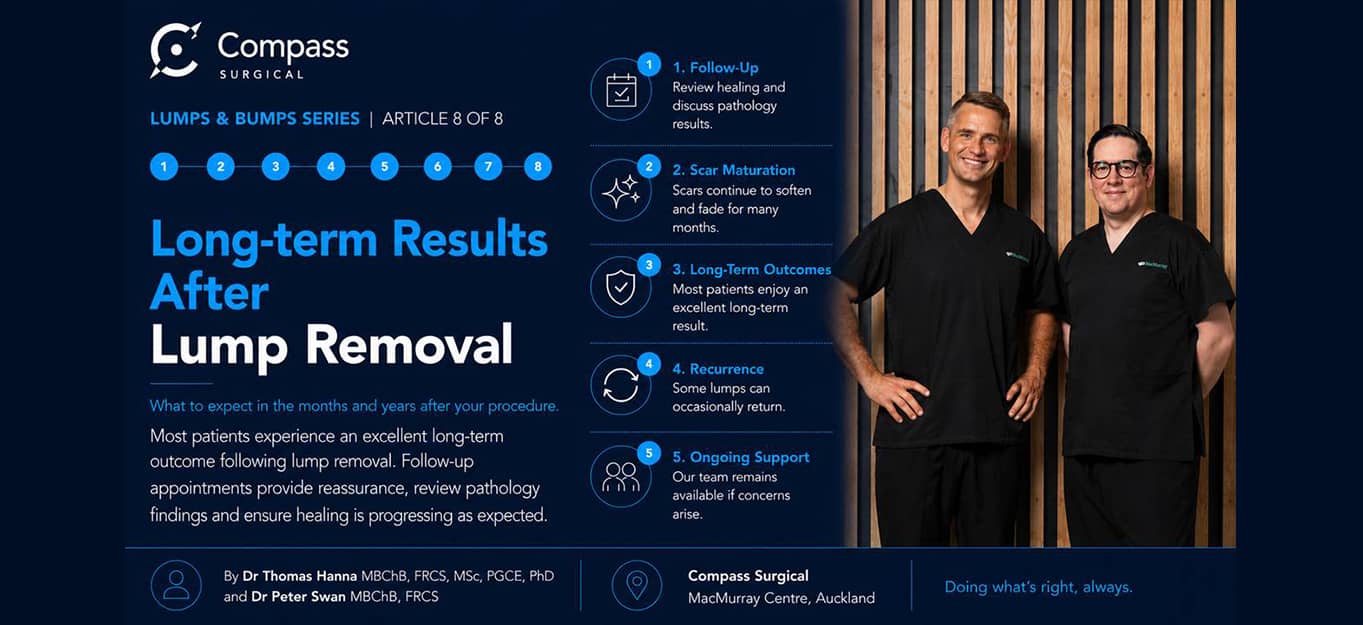
By Dr Thomas Hanna MBChB, FRCS, MSc, PGCE, PhD and Dr Peter Swan MBChB, FRACS
Compass Surgical | MacMurray Centre, Auckland
This is the final article in our 8-part guide to skin lumps, bumps and minor surgical procedures. Over the course of this series, we’ve discussed common skin lumps and bumps, how they are diagnosed, when surgery may be appropriate, what happens during removal, the risks of treatment, recovery and pathology results.
By this stage, many patients have one final question:
“What happens after everything has healed?”
For most patients, lump removal is a straightforward procedure with an excellent long-term outcome.
However, healing does not end when the dressing comes off or the stitches are removed.
Understanding what to expect in the months and years after surgery can help patients feel reassured and know when to seek advice if concerns arise.
At Compass Surgical, we believe good surgical care extends beyond the procedure itself.
Follow-up appointments provide an opportunity to:
For most patients, this appointment is reassuring and marks the final stage of treatment.
Importantly, it also allows patients to discuss any concerns directly with the surgeon who performed the procedure.
Many patients are surprised to learn that healing continues long after the skin appears normal.
While the wound itself may heal within days or weeks, the deeper tissues continue to remodel for several months.
This means it is entirely normal to notice:
These changes usually improve gradually with time.
Scars change considerably during the first year after surgery.
Initially, scars are often:
This is a normal stage of healing.
Over time, most scars:
The final appearance depends on:
Patience is important. Scar maturation often continues for 12 months or longer. For patients interested in learning more about scar healing and skin recovery after surgery, Healthify NZ provides useful patient information about wound healing and scar care.
Sometimes.
The likelihood depends on the type of lump that was removed.
For example:
Fortunately, most patients experience a durable long-term result and never require further treatment.
Where recurrence is a recognised possibility, this will usually be discussed before surgery and reviewed during follow-up.
Most patients require no further treatment once healing is complete.
However, it is sensible to seek medical advice if you notice:
Early assessment often provides reassurance and, where necessary, allows prompt treatment.
Most pathology reports confirm a benign diagnosis.
Occasionally, however, further treatment or surveillance may be recommended.
If this applies to you, your surgeon will discuss:
The vast majority of patients do not require ongoing treatment after lump removal. Patients diagnosed with skin cancer may also find information from the New Zealand Skin Cancer Foundation helpful when learning more about treatment and follow-up recommendations.
One of the advantages of specialist surgical care is continuity.
At Compass Surgical, we believe patients benefit from being assessed, treated and followed up by the same team throughout their journey.
This allows:
Successful treatment is about more than simply removing a lump.
It is about ensuring patients feel informed, supported and confident throughout the process.
Compass Surgical was founded on a simple principle:
Do the right operation, for the right patient, at the right time.
That philosophy extends throughout the entire patient journey.
Our practice is built around:
Whether treatment involves reassurance, minor surgery or further investigation, our goal is always to provide high-quality care tailored to the individual patient. If you have a skin lesion, cyst, lipoma or soft tissue lump that you would like assessed, you can contact Compass Surgical to arrange a consultation.
Skin lumps and bumps are extremely common.
Fortunately, most are benign and many can be treated with relatively simple procedures when required.
While most lumps and bumps are benign, obtaining an accurate diagnosis remains important. The best outcomes occur when patients seek advice early, understand their options and receive treatment that is tailored to their individual circumstances.
Whether the right answer is reassurance, monitoring or surgical removal, our goal remains the same: providing honest, evidence-based advice and personalised care that puts the patient first.
Throughout this series, we’ve explored:
Every patient and every lump is different.
The most important step is obtaining an accurate diagnosis and advice that is tailored to your individual circumstances.
How long does it take for a scar to fully mature?
Most scars continue to change and improve for at least 12 months after surgery.
Can a cyst come back after removal?
Yes, although recurrence is uncommon when the cyst is completely removed.
Is it normal for a scar to feel firm?
Yes. Firmness beneath a scar is a common part of the healing process and usually improves with time.
Will I need long-term follow-up?
Most patients do not require ongoing follow-up once healing is complete, although we are always happy to review patients if concerns arise.
What should I do if I notice another lump?
Arrange an assessment with your GP or surgeon. Most new lumps are benign, but review is worthwhile if a lump is growing, changing or causing concern.
If you found this article helpful, you may also wish to read:
• What Are Common Skin Lumps and Bumps? (Article 1)
• How Are Lumps and Bumps Diagnosed? (Article 2)
• Do I Need Surgery for My Lump or Bump? (Article 3)
• What Happens During Lump and Bump Removal? (Article 4)
• Recovery After Lump Removal (Article 6)
________________________________________
Dr Thomas Hanna MBChB, FRCS, MSc, PGCE, PhD
Dr Thomas Hanna is a general and transplant surgeon practising in Auckland. He trained in the United Kingdom before moving to New Zealand in 2019. He has specialist interests in hernia repair, gallbladder surgery, minimally invasive surgery and the management of skin lesions and soft tissue lumps. Tom is a founding partner of Compass Surgical and is committed to patient-centred surgical care, clear communication and surgery performed with integrity.
Dr Peter Swan MBChB, FRACS
Dr Peter Swan is a general surgeon practising in Auckland with expertise in skin lesions, soft tissue lumps, hernia repair and gallbladder surgery. He is a founding partner of Compass Surgical. Peter’s practice focuses on practical, evidence-based advice, careful patient selection and personalised treatment.
________________________________________
Compass Surgical
Doing what’s right, always.


© 2026 Compass Surgical All Rights Reserved | Privacy Policy | Terms & Conditions | Web Design by Virtual Innovation