
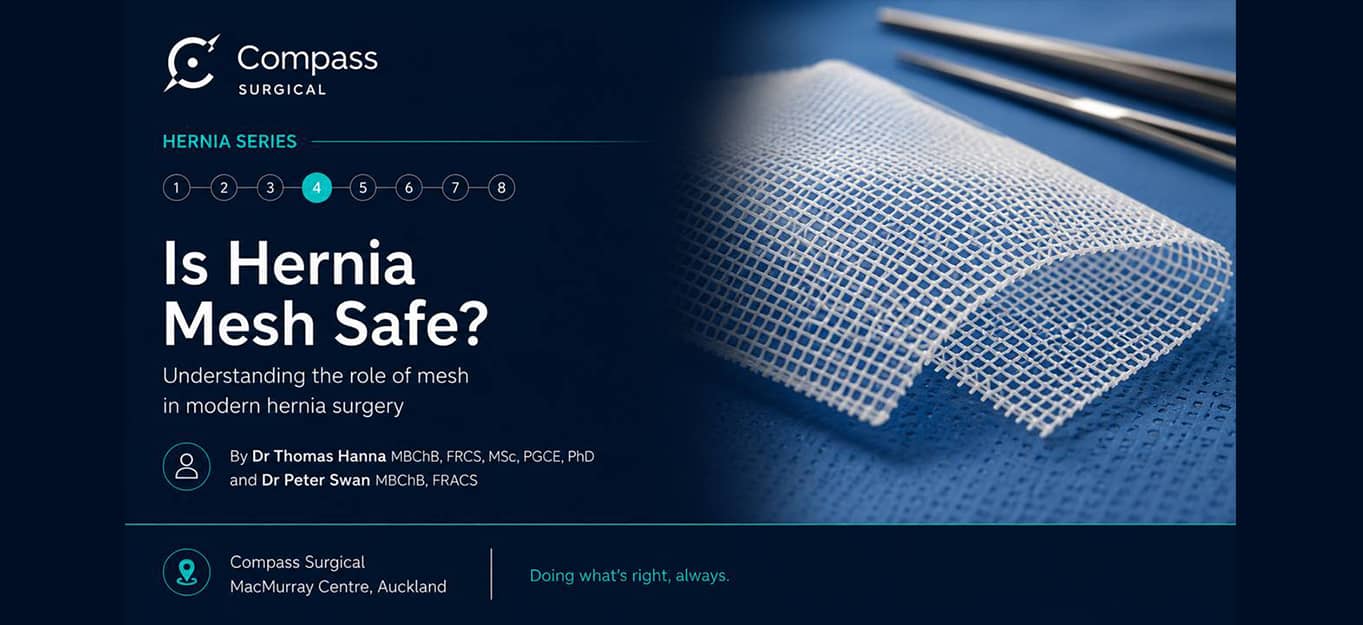
By Dr Thomas Hanna MBChB, FRCS, MSc, PGCE, PhD and Dr Peter Swan MBChB, FRACS
Compass Surgical | MacMurray Centre, Auckland
In our previous article, What Types of Hernia Repair Are Available?, we discussed the different ways hernias can be repaired and how surgeons choose the most appropriate operation for each patient.
One of the topics that generates the most questions is mesh.
Patients often ask:
“Do I really need mesh?”
“Is hernia mesh safe?”
“I’ve read concerning stories online. Should I be worried?”
These are reasonable questions.
The internet contains a huge amount of information about hernia mesh, some accurate and some misleading. Understanding why mesh is used, its benefits and its potential risks can help patients make informed decisions about their treatment.
Hernia mesh is a medical implant designed to reinforce the abdominal wall.
Most modern meshes are made from soft synthetic materials that are designed to remain permanently within the body.
Rather than simply stitching a weakness closed under tension, mesh acts as a reinforcing layer that helps strengthen the repair.
Over time, the body’s tissues grow into the mesh, creating additional support.
Today, mesh is used in the majority of hernia repairs performed worldwide. For many patients, understanding why mesh is recommended is one of the most important parts of the decision-making process before surgery.
The main reason mesh is used is to reduce the risk of the hernia returning.
Before mesh became widely available, hernias were repaired using stitches alone. While many of these repairs were successful, recurrence rates were generally higher, particularly for larger hernias.
Modern studies have consistently shown that mesh repairs reduce the risk of recurrence compared with many traditional suture-only repairs.
For most patients, this means a more durable long-term result.
Further patient information about hernias and hernia repair is available through the Royal Australasian College of Surgeons (RACS) and Te Whatu Ora
If mesh is widely used, why is there so much discussion about it?
The answer is that, like any medical implant, mesh can occasionally cause complications.
A small number of patients have experienced problems such as:
Some of these complications have received significant media attention and have understandably raised concerns among patients.
It is important to recognise that these complications are uncommon, but they are real and should be discussed openly as part of the consent process.
When patients research mesh online, they often encounter reports about complications involving pelvic mesh or mesh used in other parts of the body.
It is understandable that this creates anxiety.
However, it is important to recognise that not all mesh surgery is the same.
Many of the widely publicised concerns involved mesh placed in very different anatomical locations, often under tension or in close proximity to organs such as the bladder, bowel, rectum or vagina.
Modern hernia repairs are different.
In most groin hernia repairs, mesh is used to reinforce the abdominal wall rather than support a pelvic organ. It is usually placed in a well-established anatomical plane and is generally not in direct contact with the bowel or other abdominal organs. Importantly, the mesh is used to reinforce a weakness rather than pull tissues together under tension.
This does not mean hernia mesh is entirely risk-free. Complications such as chronic pain, infection, recurrence and, rarely, mesh-related problems can still occur.
However, the safety profile of modern hernia mesh repair is supported by decades of research and millions of successful repairs performed worldwide.
For most patients, the benefits of a stronger repair and a lower risk of recurrence significantly outweigh the risks associated with the mesh itself.
For groin hernia surgery, the most important long-term issue is chronic pain.
Most patients experience discomfort during the normal recovery period and then steadily improve.
A small proportion of patients develop pain that persists beyond the expected healing period.
The causes can be complex and may involve:
Fortunately, the vast majority of patients do not experience chronic pain and are pleased with the outcome of surgery.
Sometimes.
Selected hernias can be repaired using stitches alone.
Examples may include:
However, non-mesh repairs may carry a higher risk of recurrence depending on the type and size of the hernia.
The decision needs to balance the potential benefits of avoiding mesh against the possibility of the hernia returning.
There is no single approach that is right for every patient.
For the overwhelming majority of patients, yes.
Modern hernia mesh has been studied extensively and has helped millions of patients achieve durable repairs with low recurrence rates.
That does not mean it is risk-free.
The important point is that surgeons and patients should have an honest discussion about both the benefits and the potential complications before proceeding.
At Compass Surgical, we believe patients should understand why mesh is being recommended and what alternatives may exist.
The decision depends on several factors, including:
For many groin hernias, mesh remains the standard approach because of its excellent long-term results.
In other situations, a non-mesh repair may be reasonable.
The key is individualised decision-making rather than a one-size-fits-all approach.
At Compass Surgical, we believe patients deserve balanced, evidence-based information.
Our approach is built around:
We discuss the benefits, limitations and alternatives to mesh as part of every hernia consultation.
Our goal is not simply to perform an operation.
Our goal is to help patients make informed decisions with confidence. If you would like to learn more about hernia treatment options or discuss whether mesh or non-mesh repair may be appropriate for you, visit the Compass Surgical Contact page and arrange a consultation with one of our surgeons.
By this stage of the series, we’ve discussed what hernias are, when surgery may be appropriate, the different repair techniques available and the role of mesh.
The next step is bringing these decisions together.
In the next article, “Which Hernia Treatment Is Right for You?”, we’ll explore how surgeons tailor treatment recommendations to the individual patient, taking into account the type of hernia, lifestyle, occupation, symptoms and personal goals.
______________________________________________________________________________________________________________________________________
Is hernia mesh safe?
For most patients, yes. Modern hernia mesh has an excellent safety record and is widely used around the world.
Will I definitely need mesh?
Not always. Some hernias can be repaired without mesh, although this depends on the type and size of the hernia.
Can mesh cause chronic pain?
A small proportion of patients experience chronic pain after hernia surgery. Most patients recover without long-term problems.
Can mesh be removed?
In rare situations, mesh may need to be removed because of complications such as infection or chronic pain.
Should I avoid surgery because of concerns about mesh?
Not necessarily. The benefits and risks should be considered in the context of your individual hernia and circumstances. A discussion with an experienced surgeon can help clarify your options.
Article 1 of 8 – What Is a Hernia?
Article 2 of 8 – When Do I Need Hernia Surgery?
Article 3 of 8 – What Types of Hernia Repair Are Available?
Article 5 of 8 – What Are the Risks of Hernia Surgery?
Article 6 of 8 – What Happens on the Day of Hernia Surgery?
Article 7 of 8 – Recovery After Hernia Surgery
Article 8 of 8 – Long-Term Results After Hernia Surgery
______________________________________________________________________________________________________________________________________
Dr Thomas Hanna MBChB, FRCS, MSc, PGCE, PhD
Dr Thomas Hanna is a general and transplant surgeon practising in Auckland. He trained in the United Kingdom before moving to New Zealand in 2019. He has specialist interests in hernia repair, gallbladder surgery, minimally invasive surgery and complex abdominal surgery. Tom is a founding partner of Compass Surgical and is committed to patient-centred surgical care, clear communication and surgery performed with integrity.
Dr Peter Swan MBChB, FRACS
Dr Peter Swan is a general surgeon practising in Auckland with expertise in hernia repair, gallbladder surgery and general surgical conditions including lumps and bumps. He is a founding partner of Compass Surgical. Peter’s practice focuses on practical, evidence-based advice, careful patient selection and personalised treatment.
________________________________________
Compass Surgical
Doing what’s right, always.


© 2026 Compass Surgical All Rights Reserved | Privacy Policy | Terms & Conditions | Web Design by Virtual Innovation