
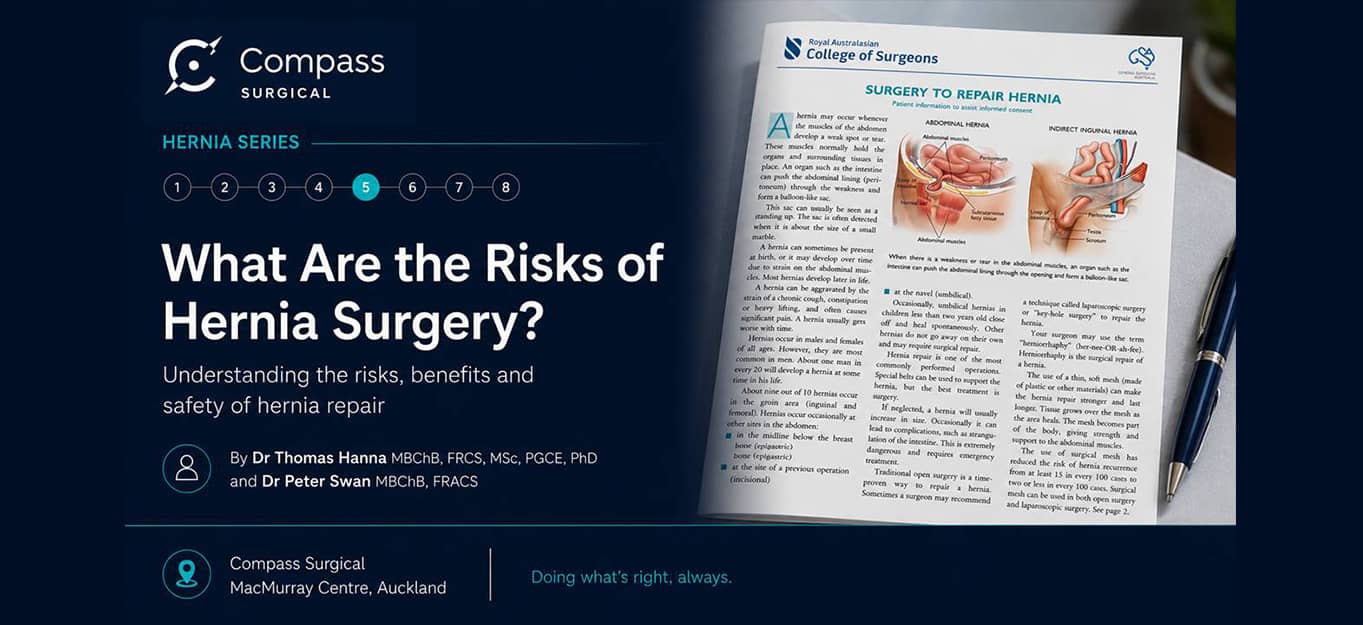
By Dr Thomas Hanna MBChB, FRCS, MSc, PGCE, PhD and Dr Peter Swan MBChB, FRACS
Compass Surgical | MacMurray Centre, Auckland
In our previous article, Is Hernia Mesh Safe?, we discussed one of the most common concerns patients have when considering hernia surgery.
The next question is often:
“What are the risks of the operation itself?”
It is an important question.
At Compass Surgical, we believe patients should have a clear understanding of both the benefits and the potential risks of surgery before making a decision.
The good news is that hernia repair is one of the most commonly performed operations worldwide, and serious complications are uncommon.
However, no operation is entirely risk-free.
Understanding those risks helps patients make informed decisions and approach surgery with realistic expectations. Understanding risk is an important part of informed consent, and one of the most valuable aspects of a surgical consultation is helping patients balance the risks of surgery against the risks of living with a hernia.
For most patients, yes.
Modern hernia surgery has an excellent safety record. Advances in anaesthesia, surgical technique and postoperative care have made recovery faster and complications less common than ever before.
Most hernia repairs are performed as day-stay procedures, and most patients recover without experiencing significant problems. Further patient information about hernias and hernia surgery is available through the Royal Australasian College of Surgeons (RACS) and Healthify NZ.
That said, every operation carries potential risks, and these should be weighed against the benefits of surgery and the risks of leaving the hernia untreated.
Most complications following hernia surgery are minor and temporary.
These can include:
Some swelling, bruising and firmness around the repair are normal parts of healing and often improve gradually over several weeks.
Less common complications can include:
The exact risks vary depending on the type of hernia and the operation being performed.
For groin hernias, important nearby structures include blood vessels, nerves and, in men, structures supplying the testicle. Injury to these structures is uncommon but forms part of the informed consent discussion.
One of the most important long-term risks of hernia surgery is persistent discomfort.
Most patients experience pain during the normal recovery period and then steadily improve.
A small proportion of patients develop discomfort that persists beyond the expected healing period.
This may relate to:
Fortunately, most patients recover well and return to normal activities without ongoing symptoms.
Careful patient selection, thoughtful operative planning and meticulous surgical technique all help reduce this risk.
Yes.
No hernia repair can guarantee a lifetime cure.
Modern repairs, particularly those using mesh reinforcement, have significantly reduced recurrence rates, and most patients achieve a durable long-term result.
Factors that can increase the risk of recurrence include:
While recurrence is possible, it is now uncommon following modern hernia repair.
We’ll discuss recurrence and long-term outcomes in more detail later in this series.
One point that is often overlooked is that avoiding surgery also carries potential risks.
Depending on the type of hernia, these may include:
The decision is therefore not simply about the risks of an operation.
It is about balancing the risks of surgery against the risks of living with the hernia. For many patients, the decision is less about whether risk exists and more about which option carries the lowest overall risk and the greatest likelihood of improving quality of life.
Patient safety begins long before the operation itself.
At Compass Surgical, we minimise risk by:
Importantly, not every patient with a hernia needs surgery. Sometimes the safest and most sensible option is continued observation. This is why treatment recommendations are always tailored to the individual rather than based on the hernia alone
Compass Surgical was founded on a simple principle:
Do the right operation, for the right patient, at the right time.
Our practice is built around:
We believe discussing risks openly is an essential part of good surgical care.
Our goal is not simply to perform an operation.
Our goal is to ensure every patient understands the risks, benefits and alternatives so they can make decisions with confidence. If you would like to learn more about hernia surgery or discuss your individual risks and treatment options, visit the Compass Surgical Contact page and arrange a consultation with one of our surgeons.
Most patients are reassured to learn that hernia surgery is commonly performed as a day-stay procedure and that recovery is often quicker than they expect.
In the next article, “Recovery After Hernia Surgery”, we’ll walk through what happens after your operation, including pain management, returning to work, exercise, driving and normal daily activities.
________________________________________________________________________
Is hernia surgery safe?
Yes. Hernia repair is one of the most commonly performed operations worldwide and has an excellent safety record.
What is the most common complication?
Minor bruising, swelling and temporary discomfort are the most common issues following surgery.
Can hernia surgery cause chronic pain?
A small proportion of patients experience ongoing discomfort after surgery, although most recover without long-term problems.
Can a hernia come back after surgery?
Yes, although recurrence is much less common with modern repair techniques than it was historically.
Will my risks be discussed before surgery?
Absolutely. Risks, benefits and alternatives are discussed carefully during consultation so patients can make informed decisions.
Article 1 of 8 – What Is a Hernia?
Article 2 of 8 – When Do I Need Hernia Surgery?
Article 3 of 8 – What Types of Hernia Repair Are Available?
Article 4 of 8 – Is Hernia Mesh Safe?
Article 6 of 8 – What Happens on the Day of Hernia Surgery?
Article 7 of 8 – Recovery After Hernia Surgery
Article 8 of 8 – Long-Term Results After Hernia Surgery
______________________________________________________________________________________________________________________________________
Dr Thomas Hanna MBChB, FRCS, MSc, PGCE, PhD
Dr Thomas Hanna is a general and transplant surgeon practising in Auckland. He trained in the United Kingdom before moving to New Zealand in 2019. He has specialist interests in hernia repair, gallbladder surgery, minimally invasive surgery and complex abdominal surgery. Tom is a founding partner of Compass Surgical and is committed to patient-centred surgical care, clear communication and surgery performed with integrity.
Dr Peter Swan MBChB, FRACS
Dr Peter Swan is a general surgeon practising in Auckland with expertise in hernia repair, gallbladder surgery and general surgical conditions including lumps and bumps. He is a founding partner of Compass Surgical. Peter’s practice focuses on practical, evidence-based advice, careful patient selection and personalised treatment.
______________________________________________________________________________________________________________________________________
Compass Surgical
Doing what’s right, always.


© 2026 Compass Surgical All Rights Reserved | Privacy Policy | Terms & Conditions | Web Design by Virtual Innovation