
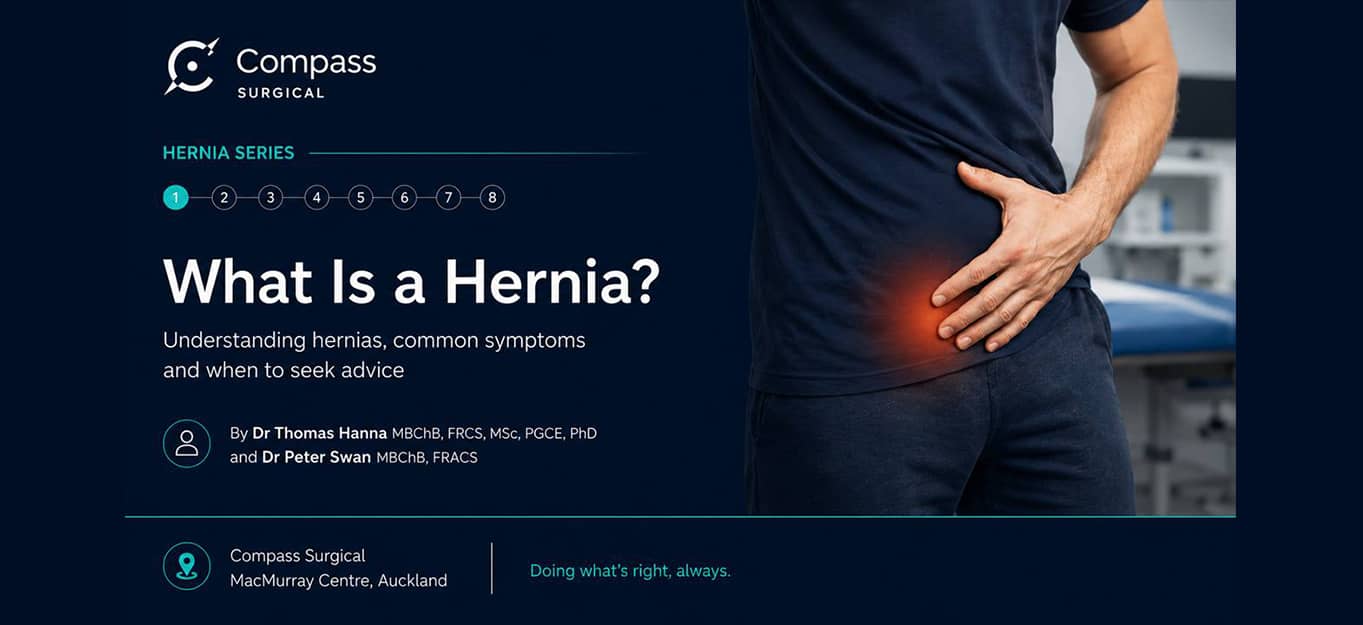
By Dr Thomas Hanna MBChB, FRCS, MSc, PGCE, PhD and Dr Peter Swan MBChB, FRACS
Compass Surgical | MacMurray Centre, Auckland
This is the first article in our series on hernias and hernia surgery.
Hernias are one of the most common conditions treated by general surgeons, yet many people are unsure exactly what a hernia is, why it develops, and whether it always needs treatment.
One of the most common questions we hear is:
“I have a lump. Could it be a hernia?”
The answer is often yes, but not every lump is a hernia, and not every hernia requires surgery.
Understanding the basics can help you recognise the symptoms, understand your treatment options and know when to seek medical advice.
In Article 2 of this series, When Do I Need Hernia Surgery?, we’ll explore when surgery is recommended, when observation may be appropriate, and how treatment decisions are individualised.
A hernia occurs when tissue from inside the abdomen pushes through a weakness in the muscles or connective tissues of the abdominal wall.
This may involve fatty tissue, the lining of the abdomen or occasionally a loop of bowel.
The result is often a lump or bulge that becomes more noticeable when standing, coughing, lifting or exercising.
A useful way to think about the abdominal wall is as a strong supportive layer that keeps the contents of the abdomen contained while allowing the body to move and generate force. When a weak spot develops, pressure from inside the abdomen can gradually push tissue through that area, creating a hernia.
Some hernias remain small and cause very few symptoms. Others gradually enlarge and become increasingly noticeable or uncomfortable.
Most hernias develop because of a combination of two factors:
The weakness may be related to natural anatomy, ageing, previous surgery or inherited tissue characteristics.
Factors that can contribute include:
Many patients worry that they caused their hernia by lifting something heavy. In reality, the weakness is often already present, and the lifting simply reveals a problem that was developing over time.
The most common symptom is a lump or bulge beneath the skin.
Patients often notice that the lump:
Many hernias are initially painless.
As time passes, patients may develop:
Interestingly, some patients notice discomfort before they ever see a lump.
The most common hernias seen in adults are:
Inguinal hernias
Occurring in the groin, these are by far the most common type and are particularly common in men.
Femoral hernias
Also occurring in the groin but slightly lower than an inguinal hernia. These are less common but are seen more frequently in women.
Umbilical hernias
Occurring around the belly button and commonly associated with pregnancy, weight gain or increased abdominal pressure.
Incisional hernias
Developing through the site of a previous surgical scar where the abdominal wall has weakened.
The exact type of hernia can influence both treatment options and the risks associated with leaving it untreated.
Many hernias can be diagnosed during a consultation and physical examination.
Often the diagnosis becomes obvious when standing, coughing or straining.
Occasionally, imaging may be helpful, particularly when:
Ultrasound is the most commonly used investigation, although CT scans are occasionally helpful in more complex situations.
Further patient information about hernias and hernia repair is available through the Royal Australasian College of Surgeons (RACS) and Healthify NZ.
Scans are useful, but they should support a clinical assessment rather than replace one.
It is worth arranging an assessment if you notice:
Urgent medical assessment should be sought if a hernia becomes:
These symptoms can occasionally indicate that bowel has become trapped within the hernia and require prompt assessment.
No.
This is one of the biggest misconceptions about hernias.
Some hernias cause very few symptoms and can be safely observed. Others gradually enlarge, become uncomfortable or begin to interfere with daily activities.
The decision to proceed with surgery depends on several factors, including:
At Compass Surgical, we believe treatment decisions should be individualised rather than automatic. For patients considering surgery, article 3 in this series explain the different types of hernia repair available, the risks and benefits of surgery are discussed in article 5 and what recovery typically involves article 7.
Compass Surgical works closely with general practitioners and the multidisciplinary team at the MacMurray Centre to provide personalised, evidence-based care.
Our approach is built around:
Our goal is not simply to diagnose a hernia.
Our goal is to help patients understand their options and make informed decisions that are right for them.
If you would like to learn more about hernia treatment options or discuss whether surgery may be appropriate for you, visit the Compass Surgical Hernia Surgery page or arrange a consultation with one of our surgeons.
One of the biggest surprises for many patients is learning that a diagnosis of a hernia does not automatically mean surgery is required.
Some hernias are best repaired early. Others can be safely monitored for a period of time.
In the next article, “When Do I Need Hernia Surgery?”, we’ll discuss when surgery is recommended, when watchful waiting may be appropriate, and how surgeons help patients decide on the best treatment approach.
If you have noticed a lump in your groin or abdominal wall, or have symptoms that may be related to a hernia, Compass Surgical can help
Working closely with your GP and the multidisciplinary team at the MacMurray Centre, we provide personalised, evidence-based advice tailored to your circumstances.
Some hernias can be safely monitored. Others are best repaired before they begin to interfere with daily activities or quality of life.
Our goal is to help you understand your options and make an informed decision with confidence.
Contact Compass Surgical to arrange a consultation.
Dr Thomas Hanna MBChB, FRCS, MSc, PGCE, PhD
Dr Thomas Hanna is a general and transplant surgeon practising in Auckland. He trained in the United Kingdom before moving to New Zealand in 2019. He has specialist interests in hernia repair, gallbladder surgery, minimally invasive surgery and complex abdominal surgery. Tom is a founding partner of Compass Surgical and is committed to patient-centred surgical care, clear communication and surgery performed with integrity.
Dr Peter Swan MBChB, FRACS
Dr Peter Swan is a general surgeon practising in Auckland with expertise in hernia repair, gallbladder surgery and general surgical conditions including lumps and bumps. He is a founding partner of Compass Surgical. Peter’s practice focuses on practical, evidence-based advice, careful patient selection and personalised treatment.
______________________________________________________________________________________________________________________________________
Compass Surgical
Doing what’s right, always.


© 2026 Compass Surgical All Rights Reserved | Privacy Policy | Terms & Conditions | Web Design by Virtual Innovation