
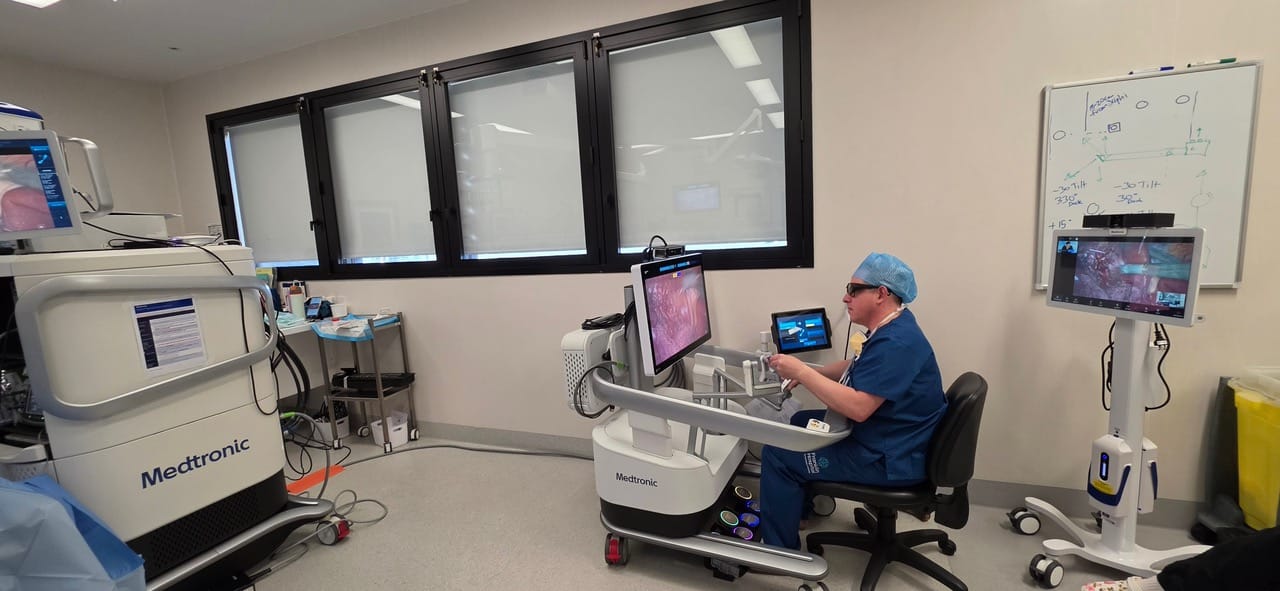
Mr Peter Swan performing a robotic-assisted hernia repair at the surgeon’s console. The surgeon controls the instruments throughout the operation.
How specialist training, emerging evidence and new technology are shaping the next phase of hernia care in Auckland
By Mr Peter Swan and Dr Tom Hanna
Compass Surgical, MacMurray Centre, Auckland
Robotic surgery is becoming an increasingly important part of modern abdominal wall and hernia surgery.
At Compass Surgical, we are developing our capability in this area deliberately. Peter Swan has undertaken dedicated training in robotic hernia surgery and has now performed a number of robotic hernia repairs in private and public practice. Tom Hanna is also developing robotic expertise and will undertake further fellowship training in Delhi, with a focus on advanced minimally invasive and robotic surgery.
We believe robotic surgery has the potential to become an important part of contemporary hernia practice. It offers genuine technical advantages and may allow some increasingly complex repairs to be performed through a minimally invasive approach.
At the same time, robotics should not be viewed as automatically better for every patient or every hernia.
The important question is not simply whether an operation can be performed robotically. It is whether using the robotic platform offers a meaningful advantage for the individual patient.
Our approach is therefore to see robotics as an additional capability alongside established open and laparoscopic techniques, allowing the operation to be tailored to the patient, the hernia and the clinical circumstances.
Abdominal wall hernias include groin hernias, most commonly inguinal hernias, as well as ventral hernias such as umbilical, epigastric and incisional hernias. Together, these are among the most common conditions treated by general surgeons and can have a significant effect on pain, work, exercise and quality of life.
Hernias can be repaired using open surgery or minimally invasive techniques.
Minimally invasive surgery includes conventional laparoscopy and robotic-assisted surgery. It is useful to think of the robotic platform as an evolution of laparoscopic surgery rather than as a completely different type of operation.
The surgeon remains in full control. The robot does not operate independently.
Small instruments are introduced through the abdominal wall and controlled by the surgeon from a console. The platform provides magnified three-dimensional vision and articulated instruments that can move with considerably more freedom than traditional straight laparoscopic instruments.
For the surgeon, the main advantages are improved visualisation, precision, dexterity and ergonomics.
For the patient, these technical advantages matter when they allow a better or less invasive operation to be performed, meaning shorter hospital stay, quicker return to normal activities and lower chance of complications.
Some hernia operations are relatively straightforward. Others require reconstruction of the layers of the abdominal wall, extensive suturing, careful positioning of mesh or work within tissue planes that can be technically demanding using conventional laparoscopic instruments.
This is where robotic surgery becomes particularly interesting.
The additional freedom of movement provided by articulated instruments can make complex suturing and reconstruction substantially easier to perform through small incisions.
That raises the possibility of combining two important goals: the reconstructive capability traditionally associated with open surgery, and the recovery advantages associated with minimally invasive surgery.
For selected ventral and incisional hernias, this may be one of the most important potential advantages of the robotic platform.
The evidence around robotic hernia surgery is developing quickly.
There is already good evidence that minimally invasive approaches can improve some patient-centred outcomes compared with open surgery in appropriately selected patients, including wound complications, length of hospital stay and recovery.
The more difficult question is whether robotic surgery produces better outcomes than well-performed conventional laparoscopic surgery.
At present, the answer is more nuanced.
Randomised and observational studies increasingly support the safety and effectiveness of robotic-assisted hernia repair. Some studies suggest advantages in particular settings, while others show broadly similar outcomes to laparoscopy.
The absence of universal superiority should not obscure the genuine strengths of the technology. Robotic surgery offers improved visualisation, instrument articulation and suturing capability, and these advantages are particularly relevant when performing more complex abdominal wall reconstruction.
The strongest case for robotics may therefore not be that it is better than laparoscopy for every routine hernia, but that it allows some operations to be performed minimally invasively that would otherwise be considerably more difficult, or require a larger open incision.
A key multicentre randomised trial by Olavarria and colleagues compared robotic and laparoscopic ventral hernia repair. Longer-term follow-up by Dhanani and colleagues has added further information.
Overall, the studies demonstrated that both techniques can produce good outcomes. There were signals suggesting possible advantages in recurrence and reoperation with robotic surgery, but the studies were not large enough to establish definitive superiority across all clinically important outcomes.
A systematic review by Ye and colleagues similarly found that robotic ventral hernia repair was safe and effective, but that operative time and cost remained important considerations and clear superiority over laparoscopy had not yet been demonstrated across all outcomes.
Taken together, we think the evidence is increasingly encouraging.
What remains uncertain is whether robotics offers a meaningful advantage over excellent conventional laparoscopy for simpler repairs.
Where the platform may offer greater value is in enabling more technically demanding minimally invasive reconstruction.
The comparison with open surgery may be particularly important.
Traditional open repair remains an excellent operation and is sometimes clearly the most appropriate approach. However, larger open abdominal wall reconstructions can involve substantial incisions, wound morbidity and a longer recovery.
Studies comparing robotic and open ventral hernia reconstruction have reported encouraging short-term outcomes, including shorter hospital stay in selected patients while maintaining similar complication and readmission profiles. Several studies support the safety and reproducibility of robotic repair compared with open approaches.
This is biologically and surgically plausible.
If the same abdominal wall reconstruction can be achieved through several small incisions rather than a large open incision, there is a reasonable expectation that some aspects of recovery may improve.
However, these studies are not perfect. Many are observational, and the patients selected for robotic repair may differ from those requiring open reconstruction.
The evidence should therefore be viewed as promising and increasingly supportive, rather than conclusive.
One of the most important lessons emerging from the robotic literature is that the technology itself is only part of the equation.
Surgeon experience matters.
Loh and colleagues examined learning curves for robotic-assisted ventral hernia repair and found that outcomes improved as surgeons gained experience with the platform.
This has practical implications.
Successful robotic surgery requires more than access to a robot. It requires structured training, mentoring, careful case selection and enough operative experience to develop proficiency.
We see this as an important part of responsible adoption.
Peter Swan has undertaken dedicated robotic training and has begun applying these techniques in both public and private practice.
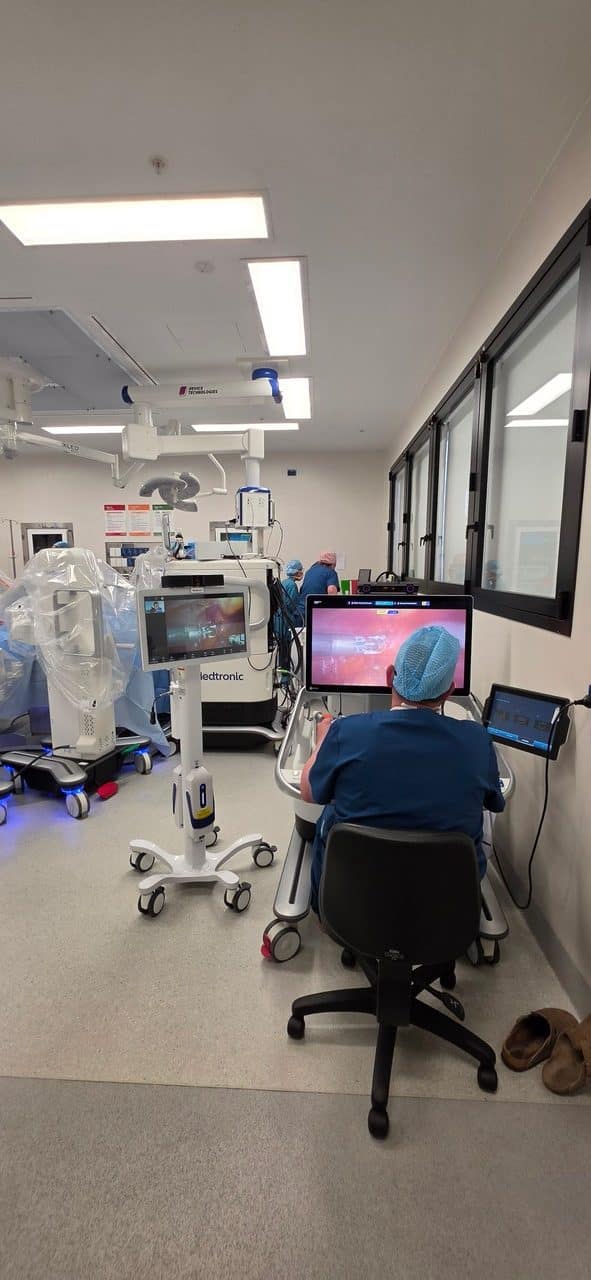
His early experience reinforces why there is growing interest in the platform. The ability to work with articulated instruments, perform precise suturing and reconstruct tissue planes through a minimally invasive approach can be particularly valuable in selected abdominal wall cases.
It has also reinforced an equally important principle: not every hernia requires robotic surgery.
Many straightforward inguinal and ventral hernias can already be treated extremely well using established open or laparoscopic techniques.
The aim of developing robotic expertise is therefore not to replace those operations. It is to broaden the range of techniques available.
Tom Hanna is also undertaking robotic training and will complete further fellowship experience in Delhi, focused on advanced robotic and minimally invasive surgery.
The purpose of this training is to build technical experience, understand appropriate case selection and bring additional robotic capability back into the Compass Surgical hernia service in Auckland.
For us, the development of expertise is as important as the acquisition of technology.
Inguinal hernia repair deserves separate consideration.
Open and laparoscopic approaches are both well established and can provide excellent outcomes.
Robotic surgery can also be used for inguinal hernia repair, and the platform can make some aspects of minimally invasive surgery technically easier. However, conventional laparoscopic inguinal hernia repair already performs very well in experienced hands.
This means robotics should not automatically be considered preferable for every straightforward inguinal hernia.
Its value may be greater in selected bilateral, recurrent or technically challenging cases (for example previous prostate surgery), or where the surgeon believes the additional articulation and visualisation provide a specific advantage.
Again, the right question is:
What is the best operation for this patient?
Cost has historically been one of the strongest criticisms of robotic surgery.
Robotic systems require significant investment in equipment, instruments, training and theatre infrastructure.
Earlier studies frequently found robotic surgery to be more expensive than laparoscopy. More recent work has suggested that the economics may be more favourable when robotics allows a patient to avoid a larger open operation and potentially reduces length of stay or early complications.
Henriksen and colleagues have reported increasingly favourable cost comparisons between robotic and open ventral hernia repair, while other large database work suggests procedural costs may become more comparable as programmes mature.
This remains an evolving area.
Cost-effectiveness will vary between health systems, hospitals, case complexity and the maturity of the robotic programme.
We would therefore not argue that robotic surgery is inherently cheaper.
Rather, its value is likely to depend on which operation it replaces, how efficiently it is delivered and which patients are selected for it.
At present, we believe the most compelling potential applications are selected patients with:
For simpler hernias, an open or conventional laparoscopic approach may still be entirely appropriate.
The important principle is that the robot should help solve a surgical problem.
The availability of the robot should not itself create the indication for surgery.
Before deciding between open, laparoscopic and robotic techniques, there is a more fundamental question:
Does the hernia need to be repaired at all?
Some minimally symptomatic hernias can be safely observed.
Others become painful, enlarge, interfere with work or exercise, or have features that make surgical repair more appropriate.
The decision to operate should therefore come before the decision about technology.
Once surgery is appropriate, the choice of operation should take into account the anatomy of the hernia, previous surgery, patient health, expected recovery, patient priorities and the experience of the surgeon.
Useful questions include:
These questions are more useful than asking whether one technology is universally better than another.
Robotic-assisted surgery is becoming an important part of contemporary abdominal wall surgery.
The platform offers genuine technical advantages, including excellent three-dimensional visualisation, highly articulated instruments and improved capability for precise suturing and reconstruction.
In selected patients, these features may allow increasingly sophisticated hernia repairs to be performed through a minimally invasive approach.
The clinical evidence is also becoming increasingly encouraging.
Studies comparing robotic surgery with open repair suggest potential advantages in recovery and hospital stay, while longer-term randomised comparisons with laparoscopy are beginning to identify areas in which robotics may offer additional benefit.
Important questions remain around patient selection, cost and long-term comparative outcomes. But we believe there is now sufficient evidence and clinical rationale to justify developing robotic expertise as an important part of a modern hernia service.
Peter Swan has already undertaken dedicated robotic hernia training and is performing robotic hernia surgery in public practice. Tom Hanna is also developing robotic capability through further training and fellowship experience.
Our aim is not to use robotics for every hernia.
It is to develop the technical experience and surgical judgement needed to identify where it offers a genuine advantage.
As the evidence, technology and surgical experience continue to evolve, we expect robotic surgery to become an increasingly important option within comprehensive abdominal wall and hernia care.
The goal remains the same: the right operation, for the right patient, using the approach most likely to deliver the best outcome.
For further information, explore our guide to when hernia surgery is needed, read about the risks of hernia surgery, or browse our patient resources.


© 2026 Compass Surgical All Rights Reserved | Privacy Policy | Terms & Conditions | Web Design by Virtual Innovation